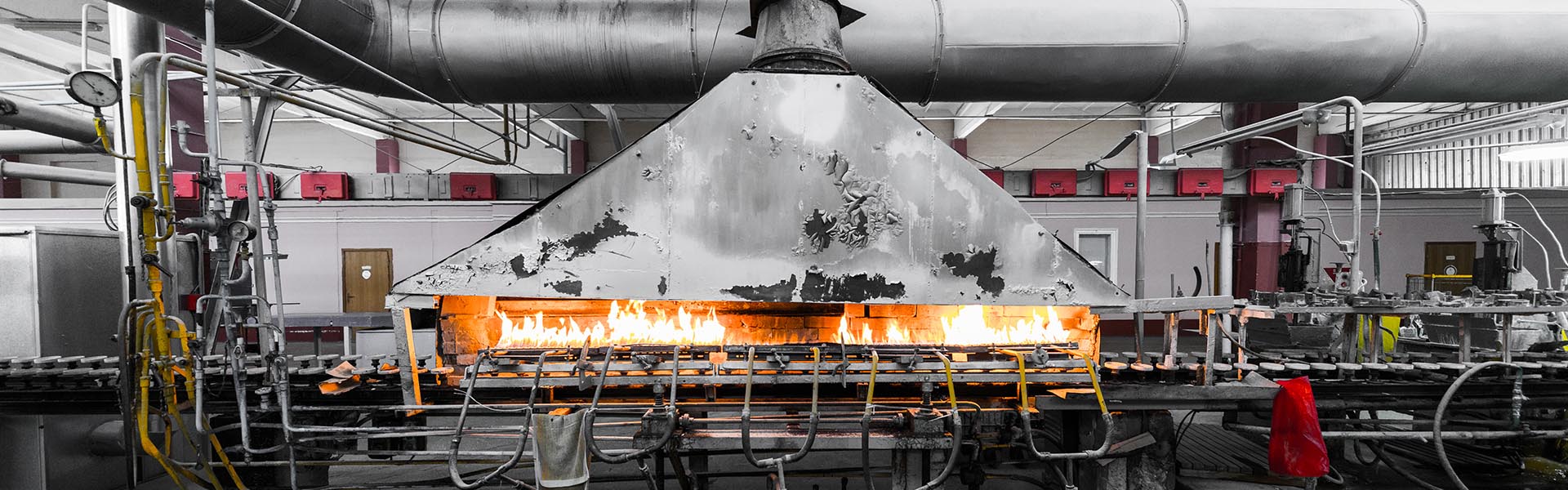
Industrial Fans & Blowers for Glass Manufacturing
Precision airflow for glass manufacturing processes that demand continuous long-term operation with frequently changing performance conditions.
AIRPRO // INDUSTRIES
Industrial Air Solutions for Glass Processing Applications
Glass manufacturing depends on steady, efficient airflow across variable temperature, continuous-duty processes. From furnace combustion air and flue gas exhaust to tempering, dust collection, and pollution control, each fan must be built around the application’s temperature, pressure, volume, and reliability requirements.
AirPro engineers industrial fans for demanding glass manufacturing environments where uptime, efficiency, and long service life matter. Whether you’re replacing an existing fan, improving furnace performance, or specifying equipment for a new system, our team can help match the right fan design to your process conditions.
WHY AIRPRO
36-Month Warranty
Industry-leading 3-year warranty coverage.
High-Temp Capabilities
Engineered for glass furnace applications, rated up to 1,800°F with specialized materials and construction.
80+% Peak Static Efficiency
Our backward curved and backward inclined fan lines achieves breakthrough efficiency — a result of extensive engineering that helps glass plants reduce auxiliary power consumption.
ISO 9001:2015 Certified
Consistent, reliable manufacturing quality backed by certification.
Application-Specific Engineering
Every fan is custom-engineered to your exact duty point — not pulled from a catalog.
Continuous-Duty Designs
Glass furnaces run around the clock, and so do our fans. Built for 24/7 operation with long service life in mind.
Glass Manufacturing Systems That Rely on Industrial Fans
Fans and blowers serve a wide range of glass manufacturing processes, including:
- Container Glass:
Bottles, jars, and packaging glass produced in large regenerative and end-fired furnaces - Flat / Architectural Glass:
Float glass production lines requiring precision combustion air control and high-temperature exhaust handling - Specialty & Technical Glass:
Borosilicate, optical, and scientific glass with precision temperature control demands - Pressed & Blown Glass:
Tableware, art glass, and industrial glassware with smaller-scale furnace and annealing requirements - Glass Recycling & Cullet Processing:
Conveying and handling systems for recycled glass with abrasion-resistant fan designs
Finding the right solution
Glass Fan Types, Arrangements & Design Considerations
Common industrial fan designs used in glass applications:
Backward Curved
BCMS / BCES / BCHD
Backward curved fans are commonly used in clean-air applications such as combustion air, forced draft, and process air. The specific model is selected based on flow and pressure requirements.
- BCMS – Medium-Volume Single-Width
A strong fit for medium-flow, medium-pressure applications. The BCMS fan line achieves up to 85.6% peak static efficiency, helping reduce power consumption in continuous-duty systems. - BCES – Enhanced-Efficiency, Single-Width
Often selected for higher-flow, medium-pressure applications where efficiency, stable performance, and long service life are priorities. - BCHD – High-Volume Double-Width
Suited for higher-flow, lower-pressure applications, including large glass furnace systems that require substantial air volume while maintaining efficient airflow performance.
Backward Inclined
BIMS / BIHS / BIHD
Backward inclined fans may be considered when slightly lower efficiency is acceptable in exchange for improved up-front cost, while still maintaining AirPro’s reliability and quality standards.
- BIMS – Medium-Volume Single-Width
A cost-effective option for medium-flow applications where dependable clean-air performance and long-term reliability are priorities. - BIHS – High-Volume Single-Width
Suitable for applications requiring higher pressure capability while maintaining a reliable, durable fan design. - BIHD – High-Volume Double-Width
Designed for higher-volume applications where up-front cost, airflow capacity, and dependable operation must be balanced.
Pressure Blowers
P### Series
Used for applications requiring higher pressure at lower to moderate airflow volumes, including burner air, localized process air, and other system-specific duties.
Available in multiple sizes and configurations to match the required pressure, volume, and installation constraints.
Fan selection considerations for glass manufacturing:
Selecting the right fan for a glass manufacturing application requires understanding the process conditions, duty cycle, and the specific role the fan plays in the system. Key considerations include:
- Temperature –
Combustion air fans typically handle ambient air; exhaust and flue gas applications pull higher temperatures according to the upstream conditions. Specialty builds rated to 1,800°F are available. - Continuous Duty –
Glass furnaces run 24/7 and often for years between rebuilds. Fan construction and bearing design must reflect that reality. - Efficiency –
Operating cost over a 15-20+ year service life makes efficiency a meaningful specification. High-efficiency fan designs reduce auxiliary power consumption. - Pressure –
Typically 5-50 inches w.g. for combustion and forced draft applications; pressure blowers for burner systems up to 130 inches w.g. - Airflow Volume –
Ranges widely by furnace size, from smaller specialty glass operations to large float glass or container lines moving hundreds of thousands of CFM. - Gas Composition –
Flue gas and exhaust streams may contain sulfur compounds, moisture, and other corrosive constituents requiring material selection consideration. - Turndown Requirements –
Glass furnaces vary in throughput. Fan control methods (VFDs, VIVs, dampers) must match the system turndown range.
Fan arrangements commonly used in glass applications:
Fan arrangements define how the fan and motor are mounted and driven. Selection depends on horsepower, maintenance access requirements, and whether the system calls for direct or belt drive. Common arrangements for glass manufacturing include:
Arrangement 1
Fan and motor mount separately on a unitary base — common for forced draft and combustion air fans.
Arrangement 3
Bearings on either side of the fan wheel, supported by separate pedestals — preferred for high-temperature and high-load glass furnace applications.
Arrangement 4
Fan wheel mounts directly on the motor shaft — a low-cost option for lighter-duty glass applications.
Arrangement 9
Motor mounts to the side of the fan pedestal — no unitary base required; useful for space-constrained installations.
Arrangement 7
For large DWDI and high-power applications — bearings on either side of the wheel, supported by the fan housing.
Fan design & accessory considerations for glass processing operations:
Glass processing fan systems must be designed around high temperatures, precise airflow requirements, continuous-duty operation, and exposure to abrasive or dust-laden materials such as batch ingredients, cullet, glass fiber, and trim. Improper fan selection can affect furnace efficiency, cooling uniformity, emissions control, equipment life, and overall production reliability.
Application-specific engineering helps ensure each fan system is matched to the process conditions, installation environment, maintenance needs, and performance requirements of the glass operation.
Industrial fans for glass processing applications may include several of the following accessories and design features:
Airflow Control
- Dampers – Variable inlet vanes, manual outlet dampers, and opposed-blade dampers help control and balance airflow at the fan inlet or outlet.
- Actuators and Positioners – Automated damper controls provide precise, repeatable airflow adjustment for combustion air, tempering, and process ventilation systems.
Vibration & Movement
- Flex Connectors / Expansion Joints — To accommodate thermal expansion in high-temperature glass furnace duct systems
- Vibration Isolators — Reduce transmitted vibration and support smoother operation.
- Vibration Sensors / Switches — Monitor mechanical health and help prevent unplanned downtime.
Process Integration
- Windbox Package – Creates a large, pressurized cavity to evenly distribute combustion air to one or more burners on glass melting furnaces, ensuring balanced airflow through burner registers
- Oven Fan / Tempering Fan Packages – Creates a large, pressurized cavity to evenly distribute combustion air to one or more burners on glass melting furnaces, ensuring balanced airflow through burner registers
Environmental & Safety
- Sound & Thermal Insulation — Reduce noise levels and limit heat transfer on high-temperature fans.
- Custom / Purge Shaft Seals — Shaft seals help separate hot or contaminated process gas from ambient conditions.
- Split Housing — Provide easier access to the wheel and shaft for inspection and maintenance.
- Abrasion-Resistant Materials & Coatings — Abrasion-resistant construction helps extend fan life in applications handling glass fiber, cullet, trim, silica dust, or other abrasive materials.
Inlet Components
- Inlet Box — Supports installations with limited inlet-side duct space.
- Inlet Filter or Screen — Protects clean-air fans from debris or contaminants.
- Inlet Silencer — Reduces noise at the fan inlet in facilities where ambient noise is a concern
- Weather Hoods — to protect outdoor fans from rain, snow, and debris
Instrumentation & Controls
- Temperature Sensors — To monitor bearing and fan health in high-temperature glass manufacturing environments
- Variable Frequency Drives (VFDs) — To control fan speed for efficient airflow modulation and smooth startup on glass furnace combustion and tempering systems.
Industrial Fan Applications Supporting the Glass Manufacturing Industry
AirPro engineers fans for the full range of airflow duties across glass manufacturing and processing operations:
Combustion Air
(Forced Draft)
200–600°F clean air; continuous duty
Glass furnaces require steady, high-efficiency combustion air for consistent heat input. Fans are sized for full furnace load, turndown range, and continuous-duty thermal conditions.
Flue Gas Exhaust
(Induced Draft)
300–800°F exhaust gas
Fans pull hot exhaust gases from furnaces and thermal systems. Designs account for high temperatures, moisture, corrosion, and shaft or bearing protection as required.
Tempering Air
Typically ambient; precise volume control required
Tempering systems require precise, adjustable airflow for rapid, uniform glass cooling. Fans support even distribution, VFD and/or variable inlet vane control, and stable performance across production changes.
Dust Collection
Ambient to moderate temp; silica or glass dust
Glass dust and silica fines require durable collection systems. Fans use sealed construction, abrasion-resistant materials, and appropriate wheel and housing selections.
Pollution Control
(Oxidizer)
High-temp exhaust; continuous duty
Fans maintain reliable draft through oxidizers, scrubbers, or exhaust treatment systems. Construction is matched to high temps and chemically-challenging airstreams.
FEATURED FAN
Cooling Fan for Glass Tempering Operations
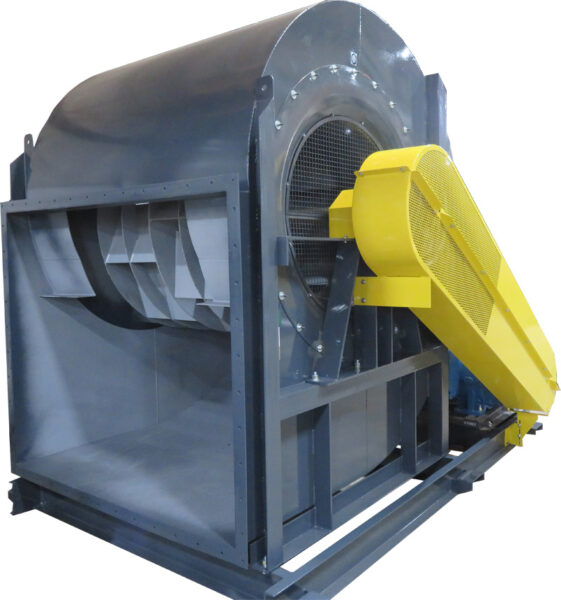
AirPro engineered a high-capacity cooling fan for the demanding airflow requirements of glass tempering. The Arrangement 3 backward inclined fan includes bearings on both sides of the wheel, a unitary base for added stability, and a double-width housing to deliver the airflow volume required for rapid cooling. Spring vibration isolators and inlet screens help support smooth, reliable operation in a high-heat, continuous-duty environment.
In glass tempering, heated glass must be cooled quickly and evenly to achieve the required strength and safety properties for automotive, architectural, and furniture applications. The backward inclined wheel’s flat blade design reduces airflow interference, improving efficiency while helping lower sound levels and energy use. This makes it well-suited for continuous tempering systems where dependable, uniform airflow is critical.
- Product Type: BIHD (backward inclined, high-volume, double-width)
- Application: Tempering Air
- Description: Size 542; Class 3; Arr. 3 (belt drive); 250 HP; 150ºF max temp design
- Performance: 112,000 CFM @ 9″ w.g. static pressure
- Features: 250 HP motor; double-width housing for increased airflow; spring vibration isolators; screened dual inlets
High-Quality Support for Glass Fans & Blowers


Connect with a Glass Manufacturing Fan Application Expert
Our experienced application engineers are ready to help you find the right fan. Whether you’re replacing an existing unit or designing a new system, we’ll make sure you get a solution that fits your specs, timeline, and budget.
Call, email, or submit your info to get started and our team will respond quickly.