Industrial Trim Handling Fans & Blowers
Engineered centrifugal fans for reliable trim conveyance, chopping, and airflow control.
AIRPRO // APPLICATIONS
Centrifugal Fans for Industrial Trim Handling
Also known as conveying or chopper fans & blowers.
AirPro trim handling fans and blowers are engineered to keep edge trim moving from pickup to collection without plugging, snagging, or overheating. Built for high velocity pneumatic conveying, our chopper and conveying fan designs deliver the pressure you need to pull trim into the system and push it reliably to a cyclone or dust collector, even when trim loads and materials change.
Heavy-duty construction and trim-focused details like a smooth no-snag interior, open wheel configurations, and abrasion-resistant material options help protect uptime in 24/7 converting and processing environments while supporting safer, cleaner operation.
WHY AIRPRO
36-Month Warranty
Industry-leading 3-year warranty coverage.
Built for High-Temperature Duty
Materials, clearances, coatings, and bearing protection are carefully selected.
ISO 9001:2015 Certified
Consistent, reliable manufacturing quality.
Application-Specific Engineering
Custom designs built to your exact duty point. Not catalog picks.
All-Brand Replacement Parts & Retrofits
Replacement and reverse engineering support fan, regardless of original manufacturer.
Factory-Backed Service
Startup, commissioning, troubleshooting & emergency repair support.
Primary Industries for Trim Handling Fans & Blowers
Your industry is often the quickest indicator of trim type, pickup method, and the conveying demands the fan must handle. Trim handling systems are common anywhere continuous web, strip, or sheet materials are slit, trimmed, rewound, stamped, or converted. AirPro supports trim removal and conveying for producers and processors of:
Plastics, Films, & Flexible Converting Materials
- Fiberglass and composites
- Films and sheets (including Mylar)
- Foils and laminates
- Labels and matrix trim
- Non-wovens and fiber webs (including facemasks/PPE, nylon fibers)
- Packaging materials
- Plastics and extrusion scrap
- Recording tape
Metals & Industrial Strip Materials
- Aluminum coil and sheet
- Copper and brass strip
- Metal foils
- Steel and stainless strip
- Metal foils
- Trim and scrap from slitting, stamping, and roll forming
Paper & Fiber-Based Materials
- Cardboard
- Corrugated board
- Fiberboard
- Paper
- Paperboard
- Textiles and industrial fabrics
Finding the right solution
Trim Handling Fan Technology Selection & Specification
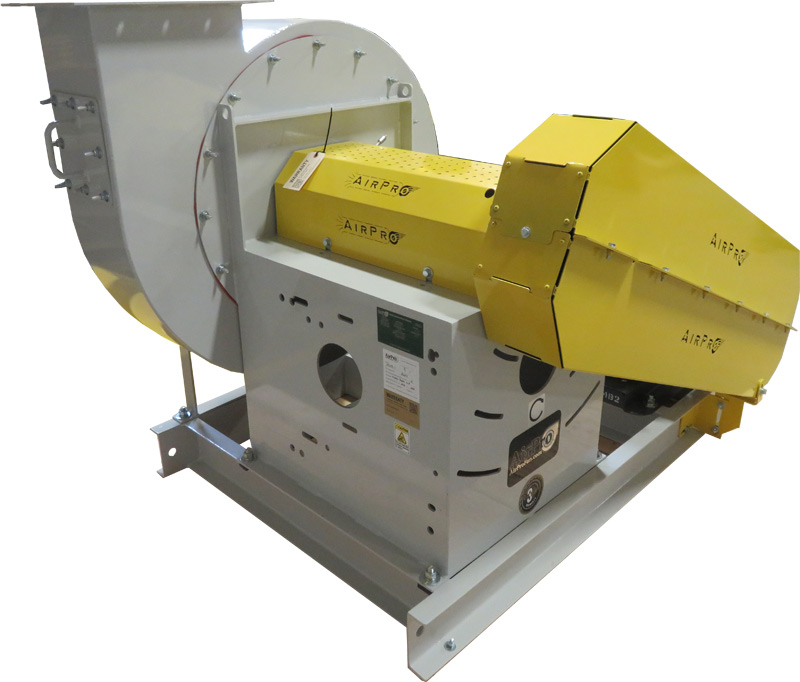
Selecting the right trim handling fan starts with one goal: keep trim and air moving from pickup to collection without allowing material to snag or build up inside the wheel or housing. Because trim can be stringy, lightweight, abrasive, or inconsistent, blade geometry, internal clearances, weld quality, and open wheel construction directly impact reliability. The fan must also generate enough pressure to maintain conveying velocity through the ductwork while handling changing trim loads.
In most trim handling systems, there are two main fan roles: one fan conveys trim to collection, and the other helps manage system airflow so the process stays stable. These roles are:
- Conveying (chopper) fan:
A primary fan that moves trim through the ductwork to a cyclone or material separator. It may operate with an upstream grinder or help reduce trim size depending on the setup.
- Balance fan:
A secondary fan used to stabilize airflow and prevent over-pressurization, often feeding the dust collector or operating on the clean side of the system.
Common Design Types for Industrial Trim Handling Fans:
Industrial Exhauster
- IETW — Trim-Handling Wheel
Open radial blade wheel, with a flat backplate and stiffener gussets for additional support and strength. Commonly used to convey and exhaust edge trim such as paper, cardboard, and light-gauge metals. - IEPW — Paddle Wheel
Open, radial blade, paddle style design used for trim conveying, where an open construction helps reduce plugging and supports consistent material movement. - IETX — Trim-Handling Extra Heavy-Duty Wheel
Built using the same core design as the IETW, with extra heavy-duty construction. - IEFB — Flat Backplate
Utilizes the same design as the IEPW, but also includes a flat backplate.
Industrial Trim Handling Fan Arrangements Commonly Used:
Fan arrangements describe how the motor mounts to and drives the fan. For trim handling and trim conveying, AirPro commonly recommends a belt drive configuration because it provides a buffer between the motor and fan wheel in case the system experiences a jam.
Trim Handling Conveyor Fans:
Typically use Arrangement 9 (belt drive), with Arrangement 1 (belt drive) as another common option.
Arrangement 1
Belt drive with an overhung impeller. The fan and motor mount separately to a unitary base.
Arrangement 9
Belt drive with an overhung impeller. The motor mounts to the side of the fan pedestal to save space compared to a unitary base.
Balance Fans:
Typically use Arrangement 8 (direct drive) or Arrangement 4 (direct drive), depending on speed control needs and footprint.
Arrangement 4
Direct drive with an overhung impeller. A low-cost arrangement, the fan wheel mounts directly on the motor shaft.
Arrangement 8
Direct drive with an overhung impeller. The fan shaft is directly coupled to the motor shaft using a flexible coupling.
Fan Design & Accessory Considerations for Trim Handling Fans & Blowers:
The priority in trim handling is simple: keep trim and air moving from pickup to discharge. If the fan wheel and housing are not designed for particulate and stringy scrap, trim can collect inside the fan, plug the system, and lead to unplanned downtime. Accumulated trim can also increase the risk of overheating and fire in certain processes. For trim handling applications, we often recommend the following design considerations:
In industrial tempering applications, we often recommend the following accessories:
- Smooth, No-Snag Interior Construction:
To minimize catch points and help keep trim and scrap moving efficiently - No-Snag Nose Cone:
To cover the wheel hub in open radial designs and reduce material hang-up - Fully Open Wheel Design with No Outer Grid:
To help prevent trim from catching during handling
- AR400 Abrasion-Resistant Carbon Steel Construction:
For heavier-duty applications such as metal and aluminum trim - Optional Teflon Coating:
For applications where reducing material buildup is a priority - Stainless Steel Construction:
On select models for applications requiring food-grade construction
In trim handling applications, we often recommend the follow accessories:
- Custom/Purge Shaft Seals
- Expansion Joints with Liners
- Motor Shaft Grounding System
- Sound and/or Thermal Insulation
- Spark Resistance
- Split Housing
- Temperature Sensors
- VFDs
- Vibration Isolators
- Vibration Sensors/Switches
- Abrasion Resistant Liners
- Chromium Carbide Liners
Connect with a Trim Handling Fan Application Expert
Our experienced application engineers are ready to help you find the right fan. Whether you’re replacing an existing unit or designing a new system, we’ll make sure you get a solution that fits your specs, timeline, and budget.
Call, email, or submit your info to get started and our team will respond quickly.
Additional Services