Industrial Spray Dryer Fans & Blowers
Engineered for efficient drying, particle separation, & reliable airflow.
AIRPRO // APPLICATIONS
Centrifugal Fans & Blowers for Spray Dryer Applications
Spray dryers, commonly used in food and pharmaceutical manufacturing, employ hot gas to convert slurry or liquid into dry powder. This process quickly atomizes the liquid or slurry through a nozzle, dispersing it into a stream of hot air or gas, where the water is vaporized, and the solid elements are separated as granules or powder.
A typical spray dryer setup includes multiple centrifugal fans—ranging from four to nine—serving various roles such as supply, exhaust, heating, cooling, and nozzle support. The supply fan draws filtered, heated air into the dryer at high velocity, while specialized components prevent particles from adhering to the fan or dryer walls.
Once the material is dried, a cyclone separates the powder, and the exhaust fan removes the vapor into an air filtration system. Cooling fans regulate the drying air pressure and product stability. The specific airflow needs and environmental conditions of your application will determine the optimal fan selection and specifications.
WHY AIRPRO
36-Month Warranty
Industry-leading 3-year coverage
High-Temp Capabilities
Rated up to 2,000°F with specialized materials and construction
ISO 9001:2015 Certified
Consistent, reliable manufacturing quality
Turnkey System Solutions
Fan-only to fully integrated packages
Application-Specific Engineering
Custom designs, not catalog picks
Factory-Backed Service
Startup, commissioning, troubleshooting & emergency repair support
All-Brand Parts Support
Replacement parts for any fan or blower
Primary Industries for Spray Dryer Fans & Blowers
Spray drying is crucial for industries such as food processing, pharmaceuticals, chemicals, and agriculture, where high-efficiency drying and consistent product quality are required. This includes:
Food Processing
- Animal feed, pet food
- Cereals, starch, sugar
- Coffee, tea
- Egg-cracking facilities
- Flavorings, spices
- Milk and whey powders
- Plant proteins
Pharmaceutical Processing
- Additives, medicinal ingredients
- Antibiotics, drugs
- Blood and plasma, blood products
- Enzymes, vitamins
- Vaccines
Industrial Processing
- Algae, microalgae
- Ceramics, paint pigments
- Chemicals, fertilizers, detergents
Spray Dryer Fan Selection & Specification
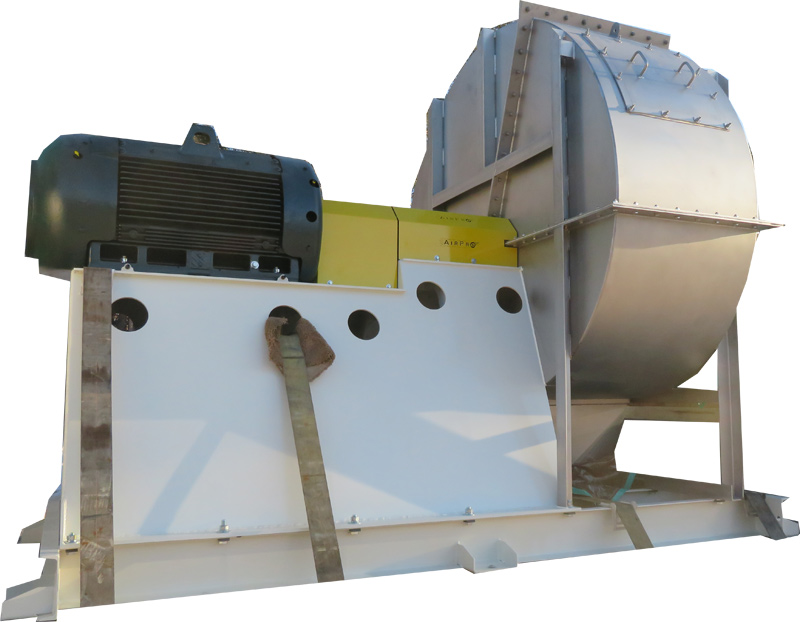
Because centrifugal fans are prominent at many points in and around the spray dryer application, virtually any of our fans could be used in one or more ways for supply air, exhaust air, process heating, or process cooling. Select and design your fans based on function, flow, and pressure. Here’s a quick overview of the top fans for each main function:
Industrial fan types commonly used in spray drying applications:
Spray Dryer Process Heating Fans
- Pressure Blowers
P##A — Shrouded Radial Aluminum Wheel
P##B — Open Radial Steel Wheel
P##C — Shrouded Radial Aluminum Wheel
P##D — Open Radial Steel Wheel
P##G — Backward Curved Shrouded Steel Wheel
XP10 — Narrow Extra Low Flow, Open
XP20 — Wide Extra Low Flow, Open
XP1S — Narrow Extra Low Flow, Shrouded
XP2S — Wide Extra Low Flow, Shrouded - Backward Curved
BCLS — Low-Volume Single-Width
BCMS — Medium-Volume Single-Width
Spray Dryer Supply Fans
- Backward Curved
BCHS — High-Volume Single-Width - Backward Inclined
BIHS — High-Volume Single-Width
Spray Dryer Exhaust Fans
- Industrial Exhausters
IEPW — Industrial Exhaust Paddle Wheel
IEFB — Industrial Exhaust Flat Backplate - Radial Tipped
RTHS — High-Volume, Single-Width
Spray Dryer Process Cooling Fans
- Backward Inclined
BIHS — High-Volume Single-Width - Backward Curved
BCHS — High-Volume Single-Width
BCMS — Medium-Volume Single-Width
BCLS — Low-Volume Single-Width
FEATURED FAN
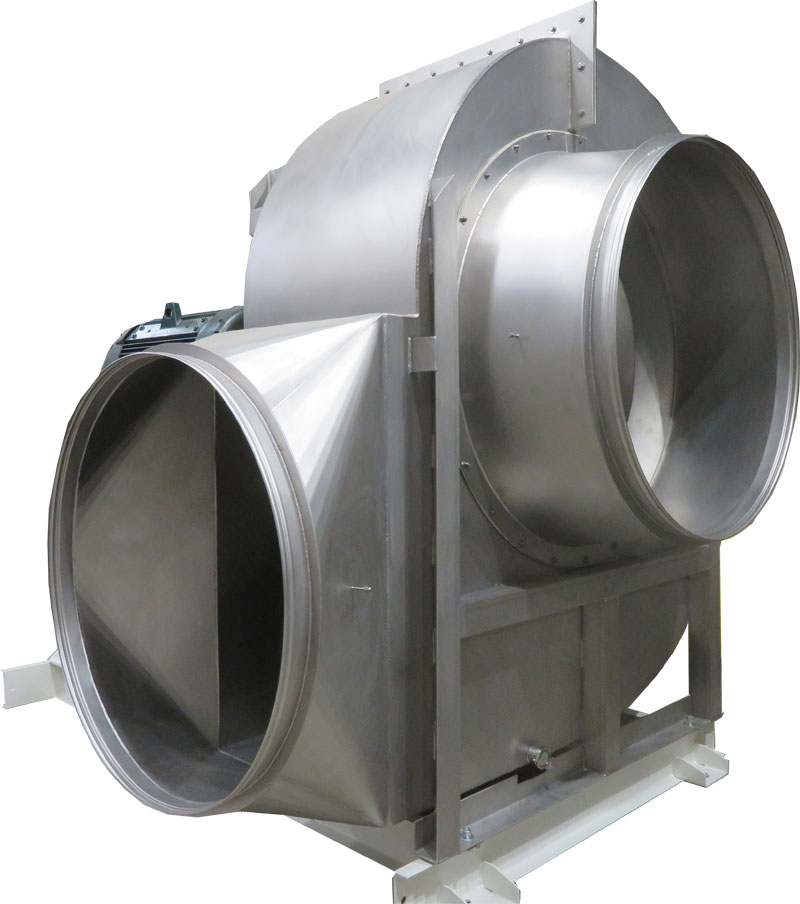
Custom Spray Dryer Exhaust Fan for Dairy Operation
AirPro engineered and built a custom spray dryer exhaust fan as part of a complete ventilation solution for a dairy operation, joining two other fans—a spray dryer supply fan and a cooling conveying fan. In dairy operations, multi-stage spray dryers are essential for ensuring optimal product quality and drying efficiency. The exhaust fan plays a critical role by pulling air and particulate from the dryer, with components designed to prevent particle buildup and ensure continuous operation.
This custom fan features a backward-curved design with an epoxy exterior coating, a Teflon shaft seal, and stainless BFM fittings. The airstream interior is crafted from 304 Stainless Steel, with continuous welding and SSPC-SP10 bead blasting for smooth, easy-to-clean surfaces. Additional features include a vibration switch, spring vibration isolators, pressure tap connections, a split housing, an outlet transition to round, and a 2” tri-clamp ferrule drain, all sanitary and FDA/USDA approved.
- Product Type: BCHS (backward curved, high-volume, single-width)
- Description: Size 542; Class 4; Arr. 8 (direct-coupled drive with unitary base); 400 HP; 200ºF max temp design
- Features: Custom-designed; epoxy exterior coating; Teflon shaft seal; stainless BFM fittings; continuous welding with SSPC-SP10 bead blast finish; spring vibration isolators; split housing; pressure tap connections; tri-clamp ferrule drain; FDA/USDA approved components.
Spray Dryer Fan Arrangements, Accessories, & Design
Common Fan Arrangements for Spray Dryer Systems
Fan arrangements indicate how the motors mount to and drive the fans. In this application, the larger supply and exhaust fans will typically run on an Arrangement 8 direct-drive motor with a variable frequency drive (VFD). The smaller cooling and heating fans are often direct-drive Arrangement 4 to minimize the fan footprint.
Arrangement 8
Direct drive with an overhung impeller. The fan shaft is directly coupled to the motor shaft with a flexible coupling.
Arrangement 4
Direct drive with an overhung impeller. A low-cost arrangement, the fan wheel mounts directly on the motor shaft.
Fan accessory & design considerations for spray dryer fans & blowers:
Proper fan design and accessory selection are critical for protecting equipment, optimizing performance, and extending the life of the fan and bearings in spray dryer operations. Spray dryers must handle high-velocity, particle-laden air streams, and prevent product from adhering to fan components.
To ensure consistent drying and efficient airflow, it’s important to design fans to accommodate variations in process load, temperature, and humidity, helping maintain reliable operation even under changing conditions.
For spray dryer applications, we often recommend:
- Flow Control Options:
Includes inlet vane dampers, variable frequency drives (VFD), outlet dampers, or a combination, each offering control over airflow volume and pressure - Actuators & Positioners:
To automate damper control for precise airflow regulation - Bearings and Motors:
Outside of the process gas stream - Custom Shaft Seals:
To separate internal hot gas from external ambient conditions - Flexible Coupling Drive:
To connect the motor to shaft in arrangement 8 configurations - Inlet Box:
A solution for installations with limited ductwork space on the inlet side - Inlet Filter or Screen:
To keep dust and debris from entering the airstream
- Silencer:
For noise control on the fan inlet or outlet (whichever is the open side) - Split Housing:
For easier maintenance access to the fan wheel and shaft - Vibration & Temperature Sensors:
To monitor bearing and fan health and prevent unplanned outages - Vibration Isolators:
When foundational mass is insufficient to support fan operation - Expansion Joints:
To absorb thermal movement and vibration between the fan and ductwork - Sound/Thermal Insulation:
To reduce noise and/or reduce external fan housing temperature for safer, quieter operation
Connect with a Spray Dryer Fan Application Expert
Our experienced application engineers are ready to help you find the right fan. Whether you’re replacing an existing unit or designing a new system, we’ll make sure you get a solution that fits your specs, timeline, and budget.
Call, email, or submit your info to get started and our team will respond quickly.
Additional Services