
Industrial Rotary Dryer Fans & Blowers
Engineered for high-capacity drying, moisture removal, & continuous process airflow.
AIRPRO // APPLICATIONS
Centrifugal Fans & Blowers for Rotary Dryer Applications
Centrifugal fans are critical to industrial drying systems, serving as both supply and exhaust fans for rotary and other industrial dryer types. This page focuses on rotary dryers as a representative application.
Rotary dryers remove moisture from foods, chemicals, biofuels, and other materials using a rotating drum and heated gas stream. A supply fan delivers heated air to the drum, while an exhaust fan pulls moisture-laden gas through downstream equipment such as cyclones, dust collectors, and scrubbers for safe, compliant operation.
AirPro designs heavy-duty centrifugal fans engineered for high temperatures, particulate loading, and continuous duty in rotary dryer applications.
WHY AIRPRO
36-Month Warranty
Industry-leading 3-year coverage
High-Temp Capabilities
Rated up to 2,000°F with specialized materials and construction
ISO 9001:2015 Certified
Consistent, reliable manufacturing quality
Turnkey System Solutions
Fan-only to fully integrated packages
Application-Specific Engineering
Custom designs, not catalog picks
Factory-Backed Service
Startup, commissioning, troubleshooting & emergency repair support
All-Brand Parts Support
Replacement parts for any fan or blower
Primary Industries for Rotary Dryer Fans & Blowers
Rotary dryers are widely used across industrial processes that require consistent, high-capacity moisture removal from bulk solids. These systems are valued for their ability to handle large material volumes, variable feed rates, and a wide range of particle sizes and moisture contents. Direct-fired rotary dryers, in particular, are well suited for demanding environments where durability, throughput, and thermal efficiency are critical. Industries that commonly rely on rotary dryer systems include:
Agriculture, Biomass & Food Processing
- Biomass
- Ethanol production
- Food processing
- Hemp processing
- Manure, cattle, and poultry processing
- Meat packing by-products
- Microbreweries and distilleries
- Peat moss
- Grain by-products and agricultural residuals
Industrial, Forestry & Specialty Materials
- Forestry and forest products
- Paper and pulp processing
- Sawdust, wood chips, and wood waste
- Industrial waste treatment
- Pharmaceutical manufacturing
- Tobacco processing
Because each industry presents unique material characteristics, moisture levels, and operating conditions, rotary dryer systems—and the fans that support them—are often custom-engineered to ensure reliable airflow, efficient drying, and long-term performance.
Finding the right solution
Rotary Dryer Fan Selection & Specification
There are two fans to consider in an industrial dryer application (plus the combustion fan, covered separately).
Industrial Fan Designs Commonly Used for Rotary Dryer Systems:
Backward Curved
- BCES — High-Efficiency Single-Width
- BCHD — High-Volume Double-Width
- BCHS — High-Volume Single-Width
- BCLS — Low-Volume Single-Width
- BCMS — Medium-Volume Single-Width
- BCNS — Narrow Single-Width
Backward Inclined
- BIHS — High-Volume Single-Width
Industrial Exhauster
- IEAH — Industrial Exhaust Air Handler
- IERS — Industrial Exhaust Radial Shrouded
Radial Tipped
- RTHS — High-Volume Single-Width
Common Fan Arrangements for Rotary Dryer Systems:
Fan arrangements indicate how the motor is mounted and how power is transmitted to the fan. In rotary dryer systems, both supply and exhaust fans are selected and configured based on their specific performance requirements, operating temperatures, and downstream process equipment.
For rotary dryer exhaust fans, the arrangement is driven by system design considerations such as emissions control equipment, dust handling requirements, and elevated operating temperatures. These factors influence shaft design, motor placement, and overall fan configuration.
For rotary dryer supply fans, motor size is the primary factor in determining the arrangement. Smaller motors—typically up to approximately 250 HP—often use a belt-driven or direct-driven configuration. Larger motors, which are common in rotary dryer applications, generally require a direct-driven coupled arrangement for efficiency, reliability, and reduced maintenance.
Arrangement 1
Belt drive with an overhung impeller. The fan and motor are mounted separately on a shared base, with power transmitted via belts.
Arrangement 4
Direct drive with an overhung impeller. A low-cost arrangement, the motor shaft is directly mounted to the impeller.
Arrangement 8
Direct drive with an overhung impeller. The fan shaft is directly coupled to the motor shaft with a flexible coupling, eliminating belts and increasing efficiency for higher horsepower applications.
Rotary Dryer Fan Accessories & Design Considerations:
When it comes to design and accessories, the focus revolves around protecting and optimizing operations, maintenance, and life of the fan and bearings. On the rotary dryer, there is an additional complication of calculating how to dry the material. If you’re not careful, you could end up too close to the maximum and still needing more speed. Because of that, we tend to recommend designing with a 15% performance margin in rotary kilns and dryers to leave a little wiggle room. In industrial dryer applications, we often recommend:
Rotary Dryer Supply Fan Accessories
- Airflow Meter:
To measure the energy transfer in the fan - Inlet Box:
A solution for installations with limited ductwork space on the inlet side - Inlet Filter or Screen:
To keep dust and debris from entering the airstream, preventing damage - Inlet Silencer:
To reduce noise at the open inlet of the fan - Flexible Coupling Drive:
To connect an arrangement 8 motor to the fan shaft - Vibration Isolators:
To protect the fan and foundation against insufficient foundation mass - Vibration & Temperature Sensors:
To monitor bearing and fan health in real time, enabling predictive maintenance and reducing unplanned downtime - Split Housing:
For easier maintenance access to the fan wheel and shaft
Rotary Dryer Exhaust Fan Accessories
- Upgraded Shaft Seal, Gaskets, & Welding:
To ensure that the moisture-laden gas stream gets all the way through the system without escaping into the plant or the atmosphere - Stainless Steel Airstream:
To prevent against corrosion over time due to the moisture in the gas stream - Inlet Box:
A solution for installations with limited ductwork space on the inlet side - Spark Resistance:
As some gas can be flammable - Vibration Isolators:
To protect the fan and foundation against insufficient foundation mass - Vibration & Temperature Sensors:
To monitor bearing and fan health in real time, enabling predictive maintenance and reducing unplanned downtime - Split Housing:
For easier maintenance access to the fan wheel and shaft
FEATURED FAN
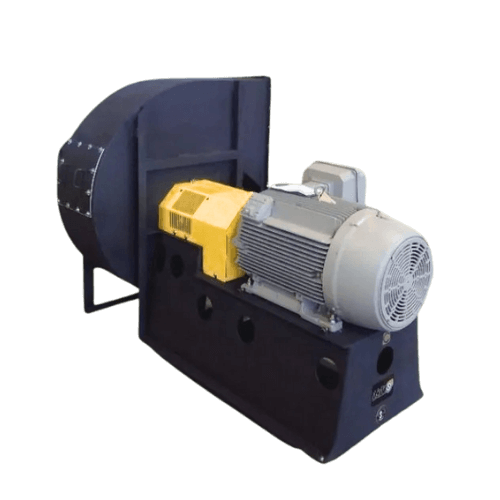
Custom Rotary Dryer Fan for Process Drying Application
AirPro engineered and built a custom RTHS radial tipped fan for a rotary dryer application supporting continuous moisture removal in an industrial drying process. Rotary dryers are used in food, biofuel, and chemical production environments where saturated gas streams and particulate-laden airflow must be handled reliably. In these systems, the exhaust fan plays a critical role by moving high volumes of hot, moisture-heavy air while maintaining stable performance.
This custom fan features a radial tipped wheel constructed from high-strength carbon steel to handle saturated gas with entrained particulate at elevated speeds. Continuous MIG welds along the housing interior help ensure an airtight airstream for proper dryer operation. Built for demanding process conditions, the fan is powered by a 250-horsepower TEFC direct-drive motor.
- Product Type: RTHS (radial-tipped, high-volume, single-width)
- Description: Size 300; Arr. 8 (direct drive); 250 HP; max design temperature 275ºF
- Performance: 30,267 ACFM @ 29.3″ wg static pressure
- Features: High-strength carbon steel construction; continuous welded housing interior; airtight design; TEFC direct-drive motor; suitable for saturated gas and particulate-laden airstreams
Connect with a Rotary Dryer Fan Application Engineer
Our experienced application engineers are ready to help you find the right fan. Whether you’re replacing an existing unit or designing a new system, we’ll make sure you get a solution that fits your specs, timeline, and budget.
Call, email, or submit your info to get started and our team will respond quickly.